Showing posts with label tween programs. Show all posts

Monday, July 25, 2011

Chocolate Olympics & Death by Chocolate

While last week I talked about programs that didn't cost money, today I'm going to share two programs I did (that were essentially the same thing) that ran me about $90 together. For drawing 60 kids, I think the cost was definitely worth it, but I think this is the kind of program that could probably be modified in many ways to be cheaper.

This is also a staff intensive program, unless you run it in a more competitive way than I did. I chose to do stations, rather than group events, except for the final contest. I had myself, two volunteers, and an additional staff member to help out, but again, I think modifications can easily be made.

I have photos from my tween stations, but I'll talk, too, about the other events I did for the teens.

The Set Up

I brainstormed and researched different ways of running this program until I found the right combination of events for my tiny space. I did plan it with the intention of doing it outside under our big tent, but with the weather throwing us a heat wave (and, um, chocolate not being good under those conditions), I had chosen the right activities to modify it for primarily indoor space.

Supplies
- Dark chocolate bars (I bought 2 of the 10 packs, but you can do more or less)
- 15 different types of candy bars (you can use more or less)
- 2 bags of mini candy bars for prizes
- 12 boxes of chocolate pudding
- Sour gummy worms
- 2 family size bags of plain M&Ms
- 1 family size bag of whoppers
- 2 large containers of chocolate sprinkles
- 2 family size boxes of oreos
- 1 or 2 bags of Hershey kisses
- Plastic cups
- Plastic spoons
- Pie tins (these were the most expensive items I bought)
- Napkins
- Construction or other painting/drawing appropriate paper
- Masking or Duct tape

The Program

Let's go station by station. At the tween event, two of the stations were set up to be unmanned, though we ended up manning one of them out of sanitary sake. In no particular order:

First up: the "Chocolate Puzzle." This was our unmanned station that we used in both programs (reusing the same materials). I purchased 15 kinds of candy bars, ranging from well-known Snickers and Butterfinger, to Kit Kat, and to the hard-to-guess Mars bar. I cut them into pieces -- halves for the smaller bars and quarters for the full size bars -- then put them into bags with a number attached. I then made up a guessing sheet that had 15 blank spots for the kids to guess which which kind of candy bar was in each bag.

I didn't put a sheet out for the kids to see the answers. Instead, I made them hold on to their response sheets until the end of the program. I had them take a seat as I held up each numbered bag and they told me their guess. I had written on the sheets that anyone who got 10 of the 15 correct would win a prize, but seeing I had a ton of prize candy, I let anyone who got 5 or more right win.


The next station I'll talk about is the "Stack and Sort." This table had two events, since they were each shorter ones.

First, the "sort." I went through the bags of M&Ms and sorted them into 30-some bags of 75 M&Ms each, with a variety of colors. I didn't count out colors for equality, just the number of candies in each bag. For this event, kids paired up and competed against another pair to see which group could sort their M&Ms by color fastest. Not as easy as it sounds, since they're working together as teams and need to have a plan. When one team finished, they were winners and got to pick out a prize. Both teams then got to enjoy their bag of M&Ms before diving into the second activity at this table.

The "stack" also relied on team work -- the pairs each took turns adding one Oreo at a time to create a tower. They were racing against another team doing the same thing. Whoever made the tallest tower won a prize. The challenge to this was, of course, the team work and the fact that the team across the table also shook the table, making the tower bases a bit unstable. When the kids finished this task, they didn't get to eat the cookies. . . until everyone had gone. Then they were able to help themselves if they wished.


What we thought would be one of the less exciting stations actually became one of the favorites: the "Whopper Relay." As you can see, we laid a piece of tape across the floor, and we had two kids line up along the wall opposite that line. They were each given one Whopper, had to get on their hands and knees, and roll the Whopper with their nose from one side of the room to that line, then they had to turn around and roll it back. The first kid to make it both ways would win.

This was easily the funniest part of the program, as we learned some kids were pretty darn good at using their nose to roll a Whopper. Even the teens loved this station and found it as funny as we did.

One of our non-pictured events was called "Chocolate Pudding Pie Surprise," and it's one we used for the teens only (due to attendance). In this program, we made up 15 pies made of chocolate pudding and dropped 6 sour gummy worms inside each. Two kids sat across the table from one another, their hands behind their back, and they had to race to retrieve the gummy worms from inside the pie using only their mouths and teeth. They were given a cup beside their pie tin to drop them into, and when they believed they'd fished out all of the worms, they were able to call stop. The person who pulled all six out first won, and they got to get a prize. We also let the kids keep their pudding pies if they wished, and I have to say, I was pretty surprised everyone wanted to keep them...and the worms.

This station wasn't one everyone wanted to do for obvious mess reasons, which is one reason I think setting it up station style was a good way to go. And keeping it for a smaller group, too, helped keep the cost/mess down. We told all of the teens if they dropped their pie from the table, they'd be responsible for licking it up off the ground.

None of the pies ended up on the floor!


Because I still wanted Tweens to play with chocolate pudding, their station was Pudding Finger Painting. This station was one meant to be unmanned, but due to sanitary concerns, we did man it.

For this, we set up a big bowl of chocolate pudding, construction paper, plastic cups, spoons, and napkins out. We told the kids they needed to spoon their "paint" from the bowl and use their cup of pudding to paint. They almost all painted something about loving chocolate, then turned to enjoying the pudding from their cups. I had worries they would lick chocolate from their fingers or spoons and put it back into the big bowl, but no one did.

Another unpictured event we had for the teens was our dark chocolate Pictionary game. Using the same yellow construction paper and two packs of dark chocolate bars, the teens pulled a clue from an envelope (where my volunteer and I had created 40 different clues) and they were to draw the clue with the chocolate bar. This was, by far, one of the favorite events, as the kids loved how the dark chocolate drew just like a brown crayon (and they loved drawing things from Harry Potter to zombies to hotels and mail boxes).

When someone guessed the correct item being drawn, they won a prize and became the drawer. Eventually, though, this program became sort of self-directed, as the kids really just wanted to draw (then eat...) the dark chocolate. Fine with me!


For the tweens, we also did a "Chocolate Shuffleboard." As you can see, I lined up two tables, not precisely flush with the walls, and I had my volunteer put duct tape down as point lines. The kids got to pick their puck from the bucket (which had Baby Ruth, Crunch, and Butterfinger bars -- think different shapes and aerodynamics!). We made four point brackets, then two extra spaces indicated as X's on the tables, and the kids lined up in groups of 2-4 at the end of the table pictured. They had three shots to score points, and whoever in the group earned the highest number of points won.

Though this was one of those last minute adds to the program, the kids enjoyed it a lot and came back more than once to do it.

Finally, we did three "Chocolate Relays" outside under the tent, despite the oppressive heat. The first involved chocolate sprinkles and cups -- the kids lined up in equal teams (we did multiple rounds for the tweens and one round with bigger teams for the teens). The first person to go was given a cup of chocolate sprinkles and a spoon, and on the opposite side of the tent, there was an empty cup. The goal was for the teams to transport the sprinkles by spoon from their side to the empty cup on the other. When the first team emptied the cup they held, the race was over, and we judged which team had gotten the most sprinkles into the other cup. The point of the race, of course, is determining if going fast was better than going slow and steady or whether it was worth doing big scoops or small scoops of sprinkles.

After that relay, we did a second one. The kids stayed in their same teams, but this time, each was given a pair of oven mitts. The first person in each team put them on, then they raced down to the table on the other end of the tent, where a bowl of Hershey Kisses waited. With the mitts on, they had to unwrap the Kiss, eat it, throw out the wrapper, then run back to their team and swap mitts with the next person up. While it sounds easy, opening the Kiss is challenging with the mitts on, ESPECIALLY when the chocolate has begun melting from the heat. Because the adults were laughing so hard at the kids, we were challenged to try it ourselves -- and we did, like the good sports we are. It was challenging, but in a very funny way. The first team to have all their players complete the task won a prize.

The final relay we did only with the teens, and it was one we came up with on the spot. Each player on a team was given a spoon and instructed to put it in their mouth. The first player needed to come down to the table then scoop a Whopper out of a plastic cup with the spoon in their mouth (we held the cups for them). They then raced back to their team, where they had to pass the Whopper from their spoon to the spoon in the next player's mouth. Then that person ran down and deposited the Whopper into the cup again and so forth. It wasn't an easy one for them, either, as we told them if the Whopper fell on the ground, they had to pick it up with the spoon in their mouths. And yes, this happened more than once. As usual, the first team to finish the relay won.

Lessons Learned

I actually had a lot more chocolate left over than I anticipated, so I was very loose with my definition of "winning." I let anyone who wanted prize candy take it, especially in the end, so it would all disappear (and it did).

One of the things I was worried about was not having enough activities and the huge mess that would come at the end. Here's the thing: because it was so staff intensive and we couldn't lead kids around from station to station, it ended up working out perfectly. The kids picked where they wanted to go, and we let them do any activity they wanted to do multiple times. As far as the clean up was concerned, there really was no mess. The messiest activity was the sprinkle race, but because it was outside, we didn't really need to clean up much of anything. All of our indoor activities were done on tables covered in the $1 table cloths that made clean up as easy as wrapping up the mess on the table and tossing it. Simple!

Without doubt, this was fun for both me and the kids, and it's a program I would not only recommend but would do again. I have a ton of other activity ideas to keep it fresh if I did it in the future. It also gives me a lot of hope that my fall "Minute to Win it" program will be as popular as this one was.

Of Note

The thing that probably surprised me the most was that we had more boys than girls in both programs. And I loved how easily transferable the activities were between the age groups, too, and both the tweens and teens had equal amounts of fun doing the silly activities.

I think this is a program that could work for the whole family, too. Pricey, sure, but for an activity that brings this much joy to both the participants and staff (and not to mention the incredible photos we've got!), it's worth doing it.

Thursday, July 21, 2011

Going Green: A Recycled Costume Show

The theme of the week is no cost programming, and today's program at work was one of the favorites so far this summer: a recycled costume show.

I mentioned before that there are always programs you inherit when you start a new job, and this is one of the traditional summer programs at my library. I think it's a really cool program and one I plan on keeping around. It's easy to organize and cost free, and it lets kids of all ages express their creativity.

Supplies

This is an easy one: anything recycled. But start saving things well in advance of your program, and have your staff help out. I had bubble wrap, packing paper, cardboard, tinsel, toilet paper and paper towel rolls, cereal boxes, soda bottles, and other regularly recyclable materials. My supplies also included most of last year's summer reading club decorations, which meant there were a ton of shark fins, some plastic shovels and goggles, and, perhaps the crowd favorite, the wicker luau fans like these.

I then pulled out glue, scissors, yarn, stick on foam shapes, craft fuzz balls, tape, duct tape, and a handful of other supplies I wanted to deplete.

Set Up

In the past, this program has been held under our big outdoor tent, with a "red carpet" positioned in the middle so that at the end of creation time, the kids could walk the runway to the MC. That was the plan for this year until we had an extreme heat warning issued, and I decided it was best to keep this program inside. The contingency plan involved putting all the non-recyclables on the floor and the craft supplies on one table. We pulled together a punch of tables for the kids to create on, some with chairs and some without (as I've found, the kids are all different about their preference, so I leave it open).

I didn't want to miss out on the kids showing off their creations, so my contingency was a library parade. I told the kids 10 minutes prior to the end of the program, we'd go on a parade throughout the stacks.

Running the Program

Like with the beaded creations program, I made no plans. Instead, I made myself available to the kids for helping with cutting, knot tying, etc. I told the kids as they came to make anything they wanted to, and they did!

As soon as creation time was done, we lined up and took a tour of the library. Some of the kids thought this parade was the best part of the program because they got to have the attention of all the patrons. Everyone got to oooh and ahhh over their costumes. Costumes ranged from an incredible robot (body and helmit with a jet pack in the back!) to a mask with a straw attached (so she could wear a mask and still drink water), as well as crowns, wigs, and bubble wrap skirts. The teens who showed up made themselves an elephant hat (which she plans to wear for Halloween) and a mailbox hat. These kids were wildly creative and imaginative, and I'm eager to go through our photos, since I know I didn't get to see everything they made.

Once our parade was done, I took the kids back to our creation space and told them the program was over, but they should feel free to take any supplies they wanted to to continue their costumes at home. Lucky for me, many of them did, meaning I had fewer things to put back into storage for next year's costume show.

Lessons Learned

What I loved about this program was it really brought in all ages. I had very young kids and I had teenagers making costume pieces. They even helped one another out, which is always one of those end goals.

I had my intern helping me out with this program, but were I doing it again, I'd love more help. While it requires little in terms of set up and in instruction, it sure helps to have people around for clean up and for taking photos and helping kids with some of the harder tasks, such as cutting tape or making holds through cardboard, etc.

I'd also make the parade a bigger deal -- I can't get too down about this, though, since this was a serious last minute improvisation for the fact I decided not to hold the program outside in the heat. But the kids loved it so much, I do plan on doing that part again. The parents got a kick out of taking photos of their kids marching in the parade, and the kids liked to show off everything they'd made (and not all of them made costumes, so not having a runway show let everyone show off what they made, regardless of whether it was wearable or not).

This is a program I highly recommend for all ages, and it's one that can be done any time of the year, and one that could be particularly well done during April's Earth Week. What a way to encourage kids to recycle and to think about the ways the things they use every day can be re-purposed. We don't always have to teach through lecturing; sometimes, it's as simple as letting them create and discover.

Costs

$0.

Really, what do you have to lose?

Monday, July 18, 2011

Beaded Creations: A Tween Program

I ran a no cost and extremely easy program last week that brought in 15 tweens for over an hour of easy fun that encouraged their creativity and imagination. You read the first part right: no cost. I called the program "beaded creations," and it involved nothing more than the craft supplies that took up shelf space in my office.

Supplies

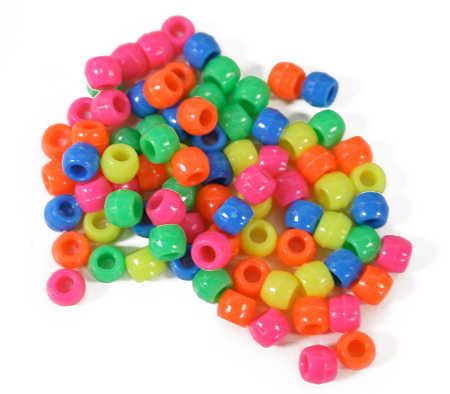
I cleaned my shelves and pulled out two boxes of beads. These included a huge tub of pony beads, as well as a number of smaller beads, fancy beads, alphabet beads, and crystal beads. I pulled out a few rolls of regular yarn, as well as fishing line thin string, some elastic, and some wire string. I still had a ton of safety pins left over from Canada Day and so I pulled those out, too. I also took out a couple tape rolls and a handful of scissors.

Set Up

I put all of the non-bead supplies on one table, save for a few pairs of scissors. That table was at the front of the room so when the kids entered, they went there first.

I grabbed a pile of bowls from our staff lounge and put a few on each of the four tables in our programming room, dumping a mix of beads into each bowl. I'm not a purist by any means, and I know I like the idea of discovery, so I mixed all the different kinds of beads together. Pony beads were hanging out with the Fs and Hs, and the crystal beads mixed with the triangle-style beads.

The Plan

Guess what? I had none. I didn't come up with any patterns, nor did I come up with any sort of jewelry for the kids to make. Instead, this was more of an open studio program, where the kids could make anything their minds could come up with. I find these programs work extremely well for this age group; they're so creative and during the school year, they're so regimented, they don't get the opportunity to just play like they need to. Yes, I said it: they need to play.

This program brought both boys and girls. The boys had just as much fun as the girls. The idea that jewelry is a girl thing isn't really common in this age group, honestly. They just want to have fun, and I'm all about encouraging it.

A couple of our boys made alphabet necklaces using all of the alphabet beads in a nonsensical way, and one of the boys found half beads he popped onto his pinkie fingers and played vikings with (then he made them party vikings by putting a ring on the fingers beneath the 'helmets'). Girls made necklaces, bracelets, and one girl used a ton of the pins to make a birthday necklace (then she gave me one of her creations to keep!).

Lessons Learned

This program was so easy and it was popular. The kids asked me to do it again, so it's one I'll definitely try out again in the spring.

Perhaps one thing I didn't think about was how much knot tying the kids would want me to do. I didn't mind it at all, but when they asked me to tie knots for their little rings, well, it was a test of my own finger dexterity (I have tiny hands, but not that tiny). I think if I do this again, I might splurge and buy actual fasteners for the jewelry so the kids could make longer lasting creations.

These sorts of programs are great for cleaning out your supplies and for encouraging creativity, and they work so well with the 8-12 year old set. You don't have to reinvent the wheel for successful programs, nor do you have to do a lot of planning or prep work. Sometimes keeping it as simple as possible is what you need to do: for the most part, these kids want a safe place to be that's not at home and they want to hang out with people their age, as well as adults who like spending time with them and laughing with them.

Wednesday, June 29, 2011

Let's go to Canada!: A Tween Program

This year's cooperative library summer theme for children is "One World, Many Stories." As part, I've incorporated a few (and I emphasize few) programs that involve travel or foreign activities. I'm not a stickler for themes, as I think they can be a bit stifling, but I took today's tweens-only program straight from the theme: Canada Day Celebration!

Like the US, Canada has a big independence day celebration, held every year on July 1. We got in on the celebration by offering up three crafts and a treat for our attendees.

First up, treat time!

I purchased a maple leaf shaped cookie cutter from Amazon, and it cost me less than $1.50. My coworker volunteered to make the cookies, which were simple sugar cookies, and I picked up 2 cans of white frosting and 2 shakers of red and white sugar crystals. Total cost was under $10, and we had between 80 and 90 cookies.

I set the supplies out and let the kids make their maple leaf cookies however they wanted. Most looked like this:


Then it was on to one of three crafts. Myself, along with a coworker and my intern, manned the craft stations. I handled the fireworks bookmarks. For this, I cut black construction paper into 1/4 strips. I hole punched the top of each and gave the kids red and white ribbon to tie. I ended up doing a lot of the tying but it wasn't a big deal. They wanted their ribbons to look like my sample.

I then let the kids lay down thick lines and shapes in glue however they wanted to. Then, they put their glue-covered black paper into a paper box lid and were given free reign over glitter.

Their creations ranged from things that kinda looked like the fireworks I made to something else entirely. I am a huge proponent of letting the kids make whatever art they want to make, so as you can see, it was a little everywhere. And little did I expect how popular this craft would be -- some kids made 4 or 5 book marks because they loved the free access to glitter.


The next craft the tweens did was make Canadian flag magnets out of fuse beads. My lovely intern was given the assignment to figure out how to turn red and white fuse beads into a Canadian flag, and she did an amazing job. We had only two of the small beds to do the flag making on, so this station was a slower one, but the kids who did it got a kick out of their final products.

Apologies for the blurry photo! If you're curious, that flag is made up of 93 red beads and 60 white, with 17 columns and 9 rows. I've included the actual pattern below (thanks Mary!):

We did the ironing of the flags when the kids finished putting the beads together, and then they were able to pop the small magnets on the backs themselves. A lot of the tweens found this to be the harder/more frustrating craft, but they all loved the end result (and let me tell you how fun it is to see a bunch of Canadian flags around the library).

The very last craft we had was a beaver pin. I found the pattern for this one right here. I picked up all of the small beads at Walmart, but let me tell you this: finding the pins was not easy. I went to multiple stores and had multiple trips before finding enough of the right size pins. Because the right size base pins were essential to fit all of the beads onto. But! There was triumph and we had all of the appropriate pins come program day.

They turned out extremely cute, and for the kids who didn't get a chance to finish, we were able to pack up some of the beads and pins for them to take home. Some of the kids wanted to make other things with their pins and again, we were game. One girl made herself a gold medal, even.

We had both guys and girls come out to the program, and it was enjoyed equally by all. We ended up having 22 kids, which is smaller than duct tape was, but still an extremely good showing for limiting the program to 9-12 year olds only. Plus, we got to celebrate Canada and the kids really got a kick out of it. It was familiar enough and foreign enough to them to be a total blast. I think the total cost was around $50 or $60, and we had a ton of left over beads and craft supplies for another program in the future, since we planned for almost 40. You could do this program on the cheap, especially if you have a lot of the supplies already.

Summer Reading: Week Two


I'm a week behind in wrapping up summer reading, so this week, there will be two in a row. This is for week two, where we got to do a lot of really exciting programs.

First, the stats: I took my counts last Thursday morning, and we had 75 teens signed up for summer reading, 252 youth age 4-12, and 51 pre-readers. That's nearly 400 people signed up already, which is almost what last year's numbers were all summer long, and we're only on week two. It feels wonderful!

We ran our regular Lego and Games club on Monday, where we had 27 attendees (up from the week before). I keep this program extremely low key, and I think that's part of why it's successful. We don't have a theme, and all I do is dump out a couple tubs of Legos on the floor and drag in a box of board games. This time, no one played games but instead, they all concentrated on making epic Lego creations.

On Tuesday, we had one of our performers who is brought in through our library system. We do all of our big programs outside under a tent, since our building's meeting room has very limited capacity. The weather looked chancey all day, but we had 97 attendees. The storyteller was a bit of a disappointment, saying she didn't need anything when really she needed a sound system (which we have). She wasn't super engaged with the kids, and she wasn't observant of what was going on around her, either. The sky grew very dark about half way through the performance, and our summer camp crew (which brings in 25-30 kids to the event) just left. After they left, so did everyone else, and the performance was cut way short. It was a little embarrassing on our end, but I'd rather the 97 attendees be safe from the weather than stay and not be. We ended up having some wicked storms from that point onto the rest of the day.

On Wednesday, we had a combined tween/teen program, where we brought in author Siobhan Vivian to do a writing workshop. There was a lot of stress to get her out here, actually, as the weather that impacted our performer on Tuesday also impacted her flight into Wisconsin. After a lot of tears and profanity on the phone, we snagged her a very early flight to Chicago Wednesday morning, where she rented a car and drove up. She did a program at three libraries that day, and I'm extremely pleased to say we drew 29 attendees. Each person who came who didn't already have a copy of her book Same Difference was able to get one, and they all got them signed after the performance. I also made everyone mini notebooks to keep, which featured the program name, date, and thank yous to our sponsors. I plan on talking about this event in more detail in another post, since it was such a great event.

After the event, I took a small group of my book club kids out for dinner with Siobhan, as well. They talked about the restaurant they ate at, and the way Siobhan talked to them about it made it so cool for the kids to see how questions can spark creativity and stories. It's one of those things I know the kids won't forget -- for them, this was meeting someone famous, and it was meeting someone who was interested in hearing their stories, too.

Thursday, I did an extremely easy program for just the teens -- ice cream creations. I cleaned out our staff kitchen, which had many half-full boxes of candy, cookies, sprinkles and more from various programs, including the candy bottle guessing game, then I made a run to the store to pick up 5 large tubs of ice cream. I also picked up a jug of chocolate sauce and a couple other sauces, a bunch of bananas, and laid out bowls, spoons, and scoops. Then, we opened the doors and told the teens to have fun. We had 29 show up for this super easy and relatively inexpensive program, and many of these attendees were the kinds of kids we'd never see in the library. All for free ice cream, indeed. But you know what? It got them in. We had a little drama with this program in policing the age of attendees, as the very young kids wanted in; we tempered this by telling the older kids to bring a scoop of ice cream out to their siblings after they ate.

Friday was our storytime, but I was on a plane down to New Orleans for the American Library Association conference, feeling pretty pleased with program attendance and signups this week. I feel like I know some of the areas where I can improve for the future, but for now, it's straight on to week three, which you'll hear about in the next couple of days.